Poker Quest is a run-like game from which you can reasonably draw connections back to Slay the Spire and Dicey Dungeons. Also available as a free flash game, I grabbed it on its deepest sale at 200y recently, played for 30 hours, and concluded it's best suited for someone like me who likes poker too much and winning every run too little.
Like many in this genre, your goal in Poker Quest is attempt to adjust the glide path of your HP such that you beat 3 (and change) bosses before crashing back to earth, and Poker Quest is exceptionally punishing in the number of plates you get to spin while being pelted with tomatoes.
(There is a Vampire Survivors-like upgrade tree available if you want to ignore many mechanics and cruise to victory, but I chose to ignore it, and if you want achievements, you will too.)
Poker Quest: Swords & Spades
one of those games where you pick nodes on a map and do turn-based fights until you beat 3 acts, but where everyone can brick due to funny drawsrelease date: 2022/11/14
completion date: 2026/05/23
post updated: 2026/05/23
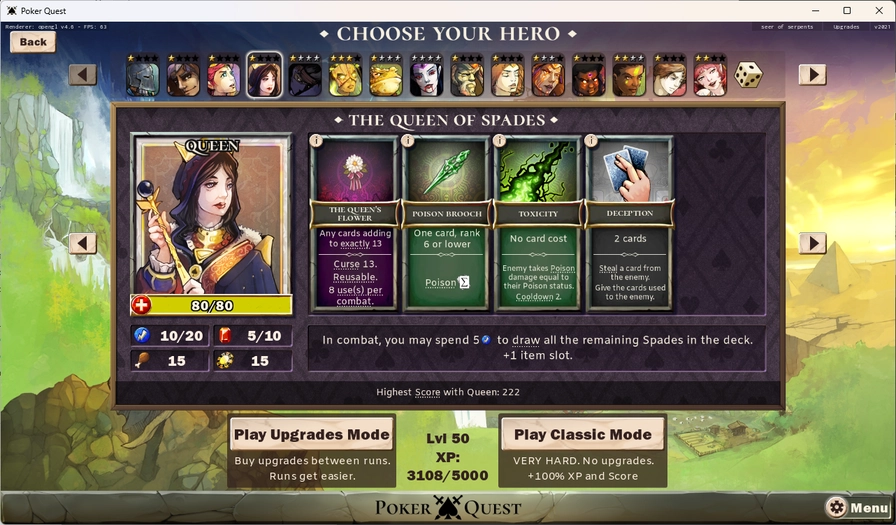
Both you and enemy draw cards from the same deck, allocating your hand to activate your equipment Dicey Dungeons style. You might have a sword that deals damage equal to double the sum of the cards placed in it, but only takes pairs, a dagger that poisons equal to the value of any card less than 7, and so on.
Enemy actions are deterministic but the game rears its love for probability by often hiding parts of enemy hands. The first boss draws 5 cards and shows 3; if they have 3 black cards they'll shield next turn, and if they have 4 red cards they'll hit you with a huge hammer this turn. You see 2 red cards. How much should you eye your once-every-other-turn panic shield?
Deckbuilder-type games have equal reliance on probability, but here, where you and your enemy have only a few possible actions each, the mental impact of bricking is much stronger. It burns when you get steamrolled by a rat drawing a pair on 5 cards like six turns in a row (about 50% each time!), but the road goes both ways, and the only difference is that bosses don't post Steam reviews when repeatedly missing their kill shot.
This element of chance underscores the vague Flash game maximalness of Poker Quest. Things will just happen to you in this game, and the game will throw every idea it has out there. There are like two dozen heroes, and a good half of those are freaky, unique builds (even if they're not always compatible with success).
Shoutouts to the Assassin, who has no actual weapons to start, but an insta-kill move that can be used for 15 energy, and 5 red bulls that can refill his energy. It's a totally distinct texture and also one that fucking sucks because his ability doesn't work against bosses! (i.e. You'll have to build a strategy for the boss from scratch, unlike other heroes.)
Poker Quest also includes a hunger system which appears to just exist to have another currency you can be constantly running out of, as if starting with 15 gold (chips) and needing to immediately pay 16 to upgrade your starting hand from 2 to 3 cards wasn't enough! (Not to mention the classic feeling of block always feeling like a feeble bandage compared to incoming damage.)
Although even if you had a lot of money, you often struggle to put together a coherent strategy given the rare shops and incredible cost of purchasing and upgrading weapons. I find that Poker Quest doesn't allow duct-taped builds to scrape across the line quite as much as, say, Balatro or Slay the Spire - here, it's hard to make a build, and unless it's a Good Build, it's a struggle.
All of this contributes to a roughness that makes Poker Quest feel, in a vaguely charming way, more like a flash game. The design is definitely not tight, and the build diversity is lacking, but if you have poker brain like me, you'll find some shining moments of breaking the system just right (whether by skill or luck).
And I wouldn't leave without mentioning some things that Poker Quest, in its shotgun approach to ideas, managed to really make land on me.
It reframes the typical 3 (and change) Act Run-Based Game, declaring you victorious after the first boss - one can choose to end the run there for a small score bonus, or 'raise the stakes' and continue into Act 2. It lessens the pressure for perfect builds, in a way where you can target an earlier off-ramp if your build isn't scaling well.
And like many of its ilk, Poker Quest has daily quests, but adds an interesting twist: you can see a heat map of what map spaces your rivals selected. It's both a teaching tool and something that stoked my competitive fire.
Every time I passed a space that was like '5 people went here; 3 people did not continue', I feel a little closer to winning a game of Poker Quest 99. (And I got in the top 5 once! I think 100 people doing a daily 4 years after release is pretty good.)
Alright that's all I got! Steam link.
Writing by invelica | Built with zola 0.20.0 | Theme by ネe3 based on futu@main